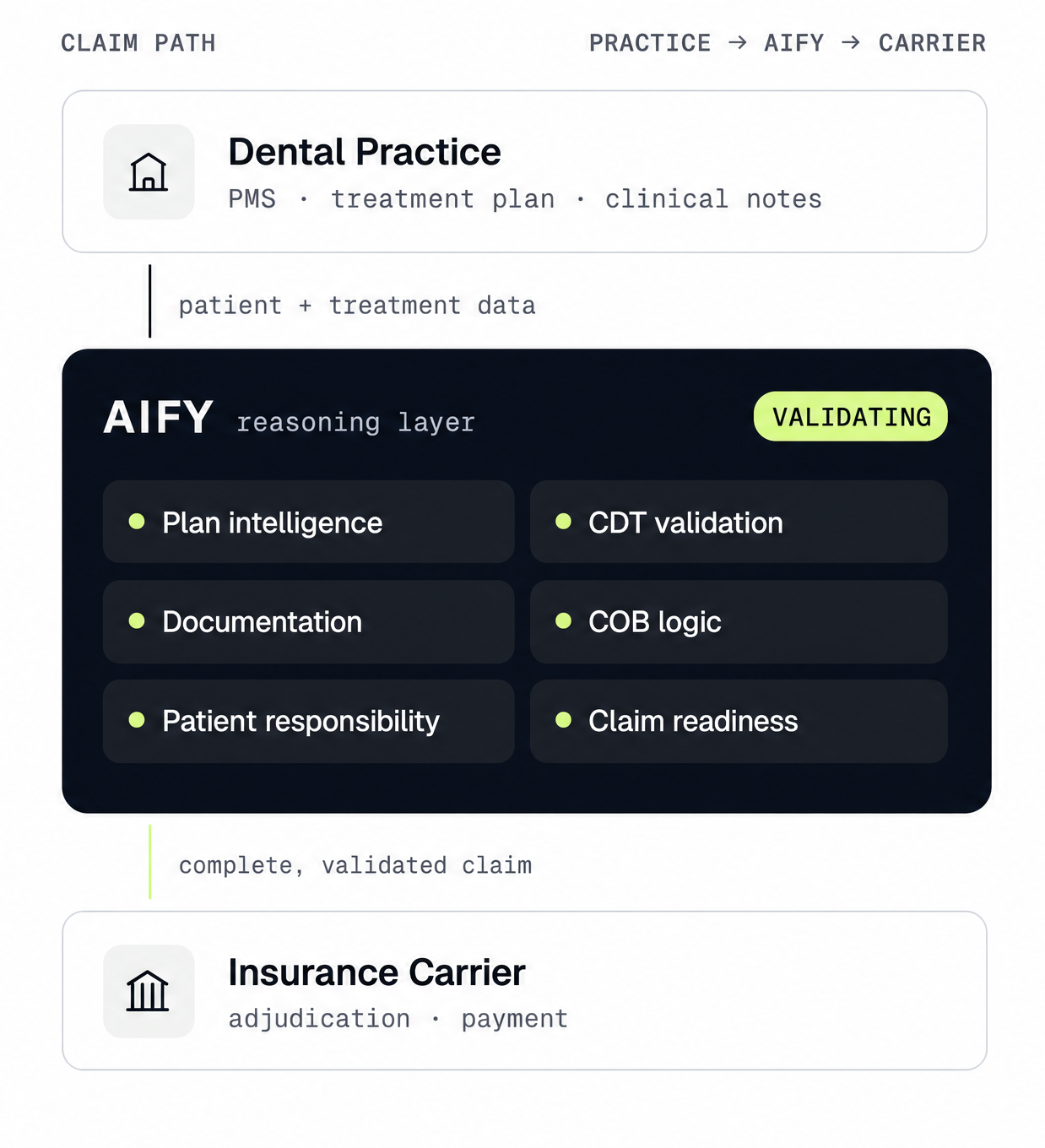
The intelligence layer between the dental practice and the insurance carrier.
AIFY is a add-on SaaS ledger that lets a practice collect what it is actually owed . It transforms the complexity of dental insurance into an intelligent, automated financial workflow, helping practices identify what can be collected, what is missing, and what needs to happen before a claim is submitted.
Dental offices are structurally set up to leave money on the table.
Every treatment code submitted to an insurer is subject to carrier-specific rules including but not limited to frequency limits, waiting periods, annual maximums, missing-tooth clauses, downgrade policies, coordination-of-benefits formulas, and required attachments and no standard dental practice software checks these rules automatically before a claim goes out.
16% loss
Average industry insurance collection rate is 84% - 16 cents of every dollar billed is never collected
innacurate Copay
Front-desk and billing staff manually estimate patient copays and claim eligibility, plan by plan, code by code, with no systematic cross-check.
workflow
Existing practice management software manages scheduling, charting, and billing records, but does not embed carrier-specific coverage rules into the claim workflow.
denied claims
The result is a steady drip of denied claims, underpaid claims, and patient billing disputes - a problem that scales with the size of the practice and is invisible until someone audits the ledger.

AIFY integrates with your practice management system and brings insurance eligibility in with it — resolved against the parameters set by that individual carrier and that individual plan, not a generic benefits summary. Coverage rules, frequency limits, waiting periods, annual maximum, deductible and downgrade policy arrive as the specific terms that apply to that patient.
1 · connects to the software you already run
Each procedure runs through the coverage rules for that patient's plan: is it covered, at what percentage, is the frequency limit already used, has the waiting period passed, does it downgrade to a cheaper alternative, does the annual maximum still have room etc.
2 · The treatment is checked, code by code
3 · The copay is calculated
What insurance is expected to pay and what the patient owes, with secondary insurance resolved through the correct coordination-of-benefits formula. The front desk quotes a number it can stand behind.
4 · The claim is checked before it goes
Fourteen pre-submission checks. Errors block submission; warnings require acknowledgement. Every alert and every acknowledgement is logged.
5 · The ledger stays current
Payments and write-offs post against the claim. Deductibles and annual maximums update as they are consumed. Denials are recorded and grouped by carrier, code and reason, so the pattern becomes visible instead of anecdotal.